Active Research
Leveraging validated LLM methods for unstructured data inputs to identify fiducial points for neutropenic enterocolitis development in pediatric acute leukemia at scale.
Applying DoWhy causal inference frameworks and NetworkX DAGs to model temporal relationships in critically ill children. Expanding to broader hemodynamic and pharmacokinetic applications.
Ongoing investigation of perioperative risk factors, mechanical ventilation duration, and post-transplant morbidity in pediatric liver transplant recipients, including the PROVE-ALT scoring model and acute-on-chronic liver failure outcomes.
Investigating pharmacologic and clinical strategies to reduce post-extubation stridor in critically ill children, with a focus on high-risk populations and protocol-driven prevention in the PICU.
Analysis of clinical outcomes, hemodynamic trajectories, and survival in pediatric patients requiring extracorporeal life support. Example projects include severe asthma requiring ECLS and long-term pulmonary outcomes in ECLS survivors.
Infrastructure
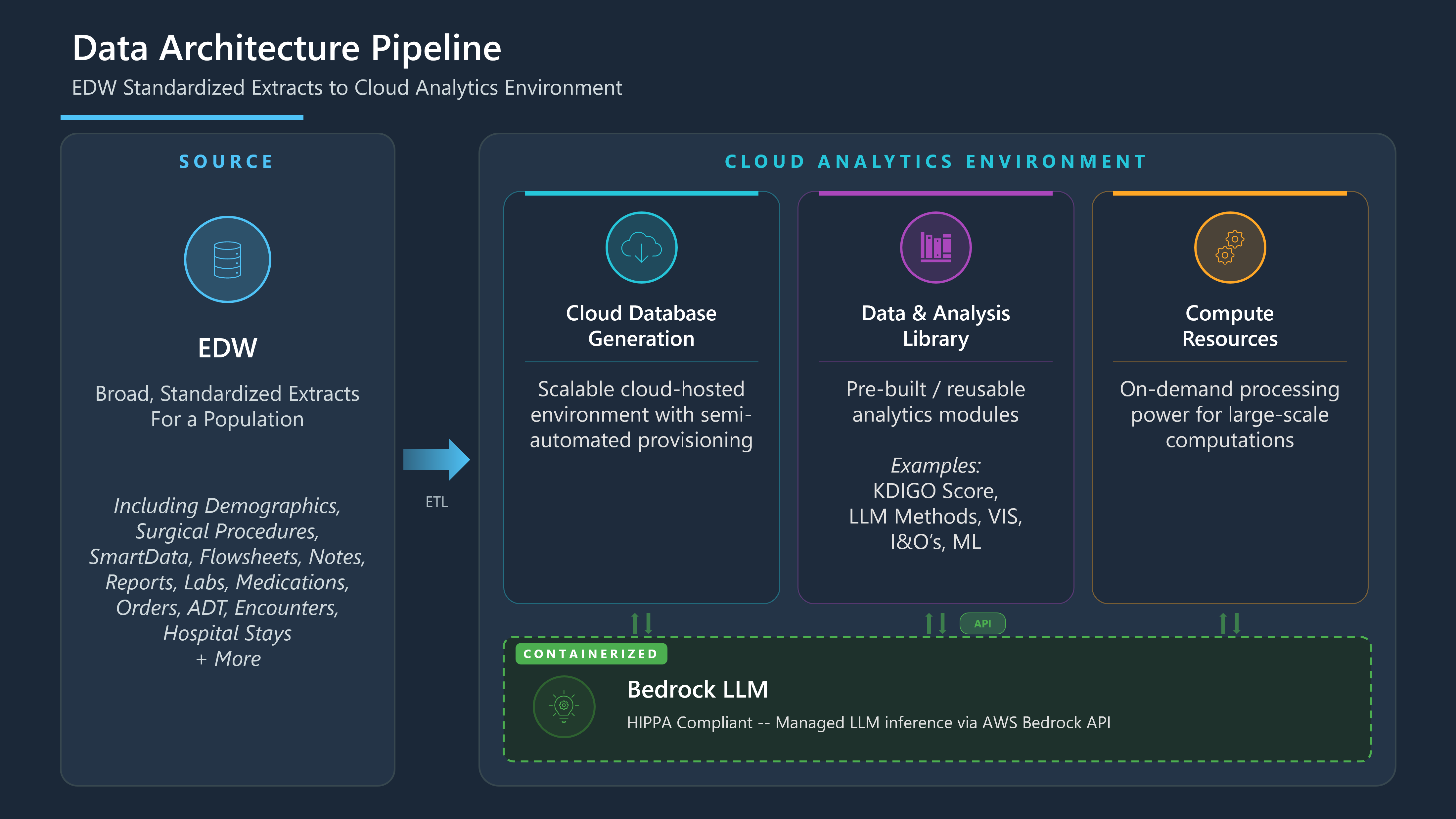 Click to expand
tflib — Clinical Analytics Pipeline
tflib is an open-source Python library built for clinical data engineering in the PICU setting. It wraps Epic EMR extraction, DuckDB feature stores, and publication-quality visualization into a cohesive, reproducible pipeline.
Designed for PHI-compliant environments, tflib provides modular components for cohort construction, KDIGO AKI staging, vasoactive infusion analysis, and LLM-based clinical NLP — all validated against real pediatric ICU data.
This repository is privately maintained. To request access or discuss a collaboration, please contact us by email.
Publications & Preprints
Interested in Collaborating?
We welcome research partnerships, data science collaborations, and clinical informatics projects in pediatric critical care. If you are working on problems at the intersection of clinical medicine and machine learning, reach out.